Before Tenjin Became a God
My wife had recommended Dazaifu Tenmangu as a must-see place for my solo trip to Fukuoka, in Kyushu. I’m not usually someone who gets motivated by the words “must-see.” But perhaps my years as a manager have improved my judgment about which recommendations are better followed than questioned. My wife’s “simple recommendations” fall into that category.
So I made the shrine my first stop.
Even on a weekday, it was full of tourists and lively groups of students.
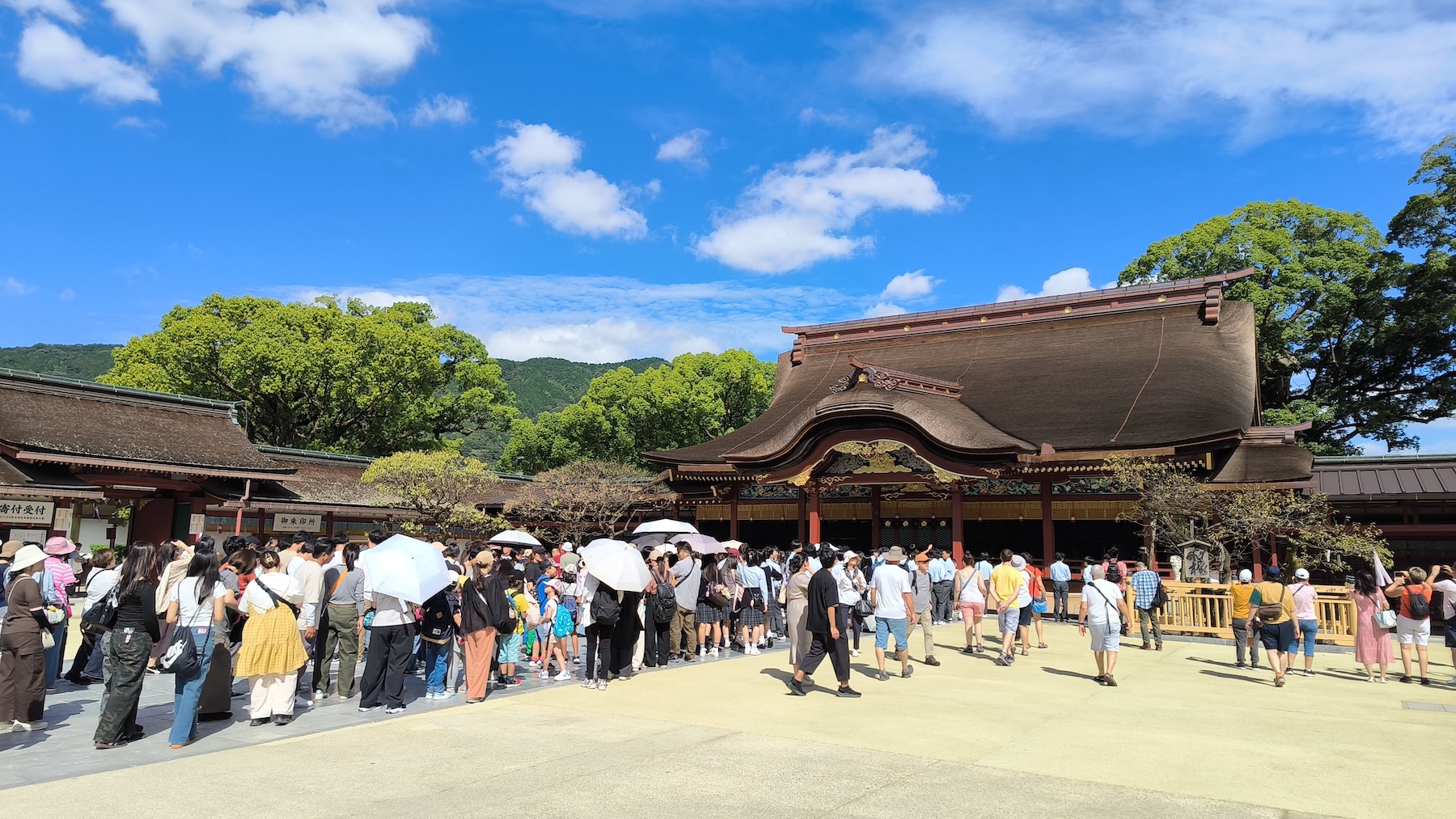 (Had I known this would end up in a blog post, I would have tried harder to take a better picture…)
Elementary school students sat together listening to their teachers. High school students lined up to pray. Wooden prayer tablets hung nearby, covered with wishes for success in school examinations.
I had done a little homework before the trip and learned that this was one of the main shrines dedicated to Tenjin. Ten (天) means sky or heaven, and jin (神) means god or deity.
The name Tenjin was already familiar to me. It’s also the name of a software project I’ve been working on for years.
I knew vaguely that Tenjin had something to do with learning. Considering how often I’d encountered the name at work (almost daily!), that was a slightly embarrassing amount of knowledge.
What surprised me most was that Tenjin had once been a human being. The shrine in front of me stood over the place where he was buried.
His name was Sugawara no Michizane (845–903).
This caught my attention immediately. How does a mortal become a god? This wasn’t Greek mythology.
The short version I found sounded like a terrible tragedy. An exceptional scholar in Heian Japan rose extraordinarily high. Political rivals had him punished for plotting against the emperor. He was sent to Dazaifu, where he died about two years later. After his death, people came to fear him as a vengeful spirit. Eventually he became Tenjin and came to be worshipped as a god of learning.
My first reaction was simple: what a poor man.
But that summary left me with questions. How did a scholar rise to one of the highest positions in the government? What had actually happened around his fall? And how had he spent the last two years of his life?
I picked up a biography of Michizane and started reading. The story grew richer, and one book led to another, and then another.
Who was this person?
If Michizane became the god of learning, I thought, he must have achieved something exceptional in that world.
He had.
He came from a family of scholars. In ninth-century Japan, that meant studying the Chinese classics, history, literature, and language. These were also practical skills: the ability to read, interpret, and compose such texts mattered directly to governing a country.
He was a teacher. At 33, unusually young for the appointment, he became Monjo Hakase (文章博士), the highest academic office in his field. Only two people could hold the post at a time. He taught Chinese literature and history at the court’s academy and gave lectures to the emperor and ministers.
He was a writer. The court relied on him to draft imperial edicts and other formal texts. He also worked on officially commissioned histories. His ability with words was useful to people running the country.
He was also a poet of exceptional talent.
This is where Michizane became unexpectedly close to me. As a Chinese reader, I find his Chinese poems beautiful. There is something almost unreal about reading words written by a Japanese man more than 1,100 years ago and still feeling their beauty in my own language.
Many books in Japan present his Chinese poems with Japanese readings or translations. I was glad that one of the books I read showed the poems in their original Chinese. I could read his words as he had written them.
Now I could relate to this historical figure a lot more. I was starting to see someone whose interests weren’t so different from mine.
So, he was an exceptional scholar. But how did that make him the second-highest minister in the government? What made such a leap possible?
Why did he rise so high?
That brought me to Emperor Uda.
The political world around Uda included the powerful Fujiwara family. Their daughters married into the imperial family, and their children could become emperors. Leading Fujiwara men could then stand close to the throne as maternal relatives, serving as regents for child emperors or powerful advisers to adult ones.
Uda wanted more room to govern on his own. After losing a trusted scholar and adviser, he had an important gap to fill. Michizane brought deep scholarly knowledge and the ability to apply it to the practical work of government.
This helped me see why Uda’s trust mattered so much. Michizane had the ability, and Uda had a particular need for that ability. That combination opened a path for Michizane far beyond the scholarly career he had built.
His promotions followed at extraordinary speed. After joining Uda’s government in 890, he became head of the emperor’s secretariat in 891. Michizane’s excellent work and Chinese poetry continued to impress Uda, and he kept being promoted.
Then, in 897, Uda abdicated in favor of his son Daigo. Uda entrusted Michizane to the new emperor, and Daigo initially continued his father’s reliance on him.
In 899, Michizane became Minister of the Right, effectively the second-highest minister in the government. Above him was Fujiwara no Tokihira, the Minister of the Left.
Nine years after joining Uda’s government, Michizane had reached almost the top of it.
Then how did he fall?
Tokihira stood beside Michizane at the top of the government. In the familiar account, he is the rival who becomes the villain: the powerful man whose jealousy brings the scholar down.
Michizane’s position, meanwhile, remained closely connected with Uda, even after Uda had handed the throne to his son. The emperor who had elevated him was now the former emperor, but Uda remained active and continued spending time with Michizane and other close attendants.
The transition from father to son was not simply a clean transfer of power. People around both emperors had their own positions and futures to think about.
Then, in 901, Michizane was accused of plotting to remove Daigo and replace him with Daigo’s brother, who had married Michizane’s daughter.
The family connection made the accusation particularly serious: one of the government’s highest ministers was accused of trying to put his own son-in-law on the throne.
Daigo acted on the accusation. Michizane was demoted and sent from Kyoto to Dazaifu in Kyushu. He retained an official title, but his place at the center of government was gone. In practice, it was exile.
His family was broken apart too. His grown sons were sent to other provinces. His wife and daughters remained in Kyoto. Michizane traveled to Dazaifu with two young children and one elderly servant.
The journey itself was difficult, but what stayed with me more was the life waiting for him at the end of it.
The tragedy didn’t stop there. One of the boys who had traveled with him died. Then news reached him that his wife had died in Kyoto.
During those years in Dazaifu, he continued writing Chinese poems. He reflected on his life and what had happened to him. He wrote of his innocence, his sorrow, and a spirit that felt broken. Yet even after everything that had happened, his writing still showed loyalty to the emperor and a longing to return to Kyoto.
He died in Dazaifu in 903, about two years after being sent away.
He never returned to Kyoto.
Where was Uda?
By this point, one thing kept bothering me. What had happened to the emperor who had trusted Michizane so deeply and helped bring him so high?
Uda did try to intervene.
By then, Uda had become a Buddhist monk. When Michizane fell, he went to the palace to speak to Daigo in his defense. He was refused entry. Uda spread out a straw mat outside the palace and sat there for the whole day, waiting for a chance to speak to his son. But an official close to Tokihira did not tell Daigo that his father was waiting outside.
That changed how I thought about Uda’s part in the story. His trust had made Michizane shine. Every promotion had also tied the scholar more closely to Uda’s political world, giving others more reason to see him through his relationship with the emperor.
When the center of power moved, that same connection could cast a shadow.
Uda had tried. Uda’s attempt had failed. That was harder to take in than simply imagining that Uda had forgotten him.
Was Michizane really innocent?
The commonly told version was that Tokihira was the one who led the conspiracy against Michizane. However, there was also evidence suggesting that the plot to dethrone Daigo itself may have existed.
One of the books mentions something Michizane said after his exile, when someone visited him in Dazaifu. He maintained that he had not plotted anything himself, but also said that he had failed to prevent the idea from developing–or to avoid being drawn into it.
It is possible that one of Uda’s close aides pursued the plan, running ahead of Uda’s or Michizane’s own intentions. People in Uda’s circle would have seen Michizane as being on their side. And because Michizane’s daughter had married Daigo’s brother, it was not difficult to see how replacing Daigo with Michizane’s son-in-law could strengthen their own position and influence.
What happens when other people act in what they believe to be your interest, and you cannot fully control what they do?
That question complicated the simple story of an innocent scholar and a jealous rival.
Seven times
One thing I kept track of while reading was Michizane’s resignation requests. I counted seven over the years. All seven were rejected.
The requests came at several stages of his rise, including his promotion to Minister of the Right and his concurrent military command. He repeatedly pointed to his background: he came from a scholarly family, and he felt he had risen too high.
Seven times.
To me, they suggest that Michizane was humble, but also very aware of his own position and what was happening around him. He pushed even harder to resign once he was promoted to Minister of the Right. By then, the jealousy and criticism around his extraordinary rise were no longer subtle.
Learning, teaching, writing, and serving–those were the things that drove him. Yet he had risen to such a position that he could no longer decide the trajectory of his own life.
Was Tokihira the whole explanation?
I was also starting to think differently about Tokihira. His role in Michizane’s downfall still mattered. But the story was becoming harder for me to reduce to one man hating another until he destroyed him.
The transition from Uda to Daigo had begun with continuity. Daigo followed his father’s guidance and promoted Michizane even further. But people around both emperors had positions and futures of their own to think about.
Those close to Uda risked losing influence as Daigo strengthened his own position as emperor. Those around Daigo and Tokihira had reason to watch how much influence the former emperor’s circle still held. A promotion, a marriage, access to the emperor–each could change where someone stood.
The same action could also look different depending on where you were standing. Supporting someone close to Uda could look, from the other side, like preserving the former emperor’s influence. Protecting the new emperor’s authority could mean pushing Uda’s trusted people further away.
This is where I started thinking about political gravity.
Under Uda, Michizane’s talent and Uda’s political needs had worked in the same direction and helped pull him upward. But once Michizane was near the top, other people’s positions and interests became connected to his. People close to Uda could see Michizane as important to maintaining their own influence, while people gathering around Daigo had reasons to see that same influence as a problem.
Even without Tokihira, those structural pressures and conflicts would still have existed. Uda’s circle had influence to protect, Daigo’s side had its own position to establish, and Michizane’s family connection to Daigo’s brother remained.
I’m not trying to say that what happened was inevitable. I still believe individual choices mattered. I just started to see forces in the situation that were larger than the personal relationship between two men.
The same political gravity that had helped pull Michizane upward was now working in the other direction.
He seems to have recognized some of the danger. He tried repeatedly to step away. But he could not make the people who wanted him in those positions let him go.
When he finally left Kyoto, it was because he had been sent away, with his family scattered.
Thinking back to Enoki-sha
After learning all this, I kept thinking back to Enoki-sha.
Enoki-sha is a tiny shrine in the residential area where Michizane spent his final years in Dazaifu. It was one of the places I specifically wanted to visit on this trip.
It was completely different from Dazaifu Tenmangu.
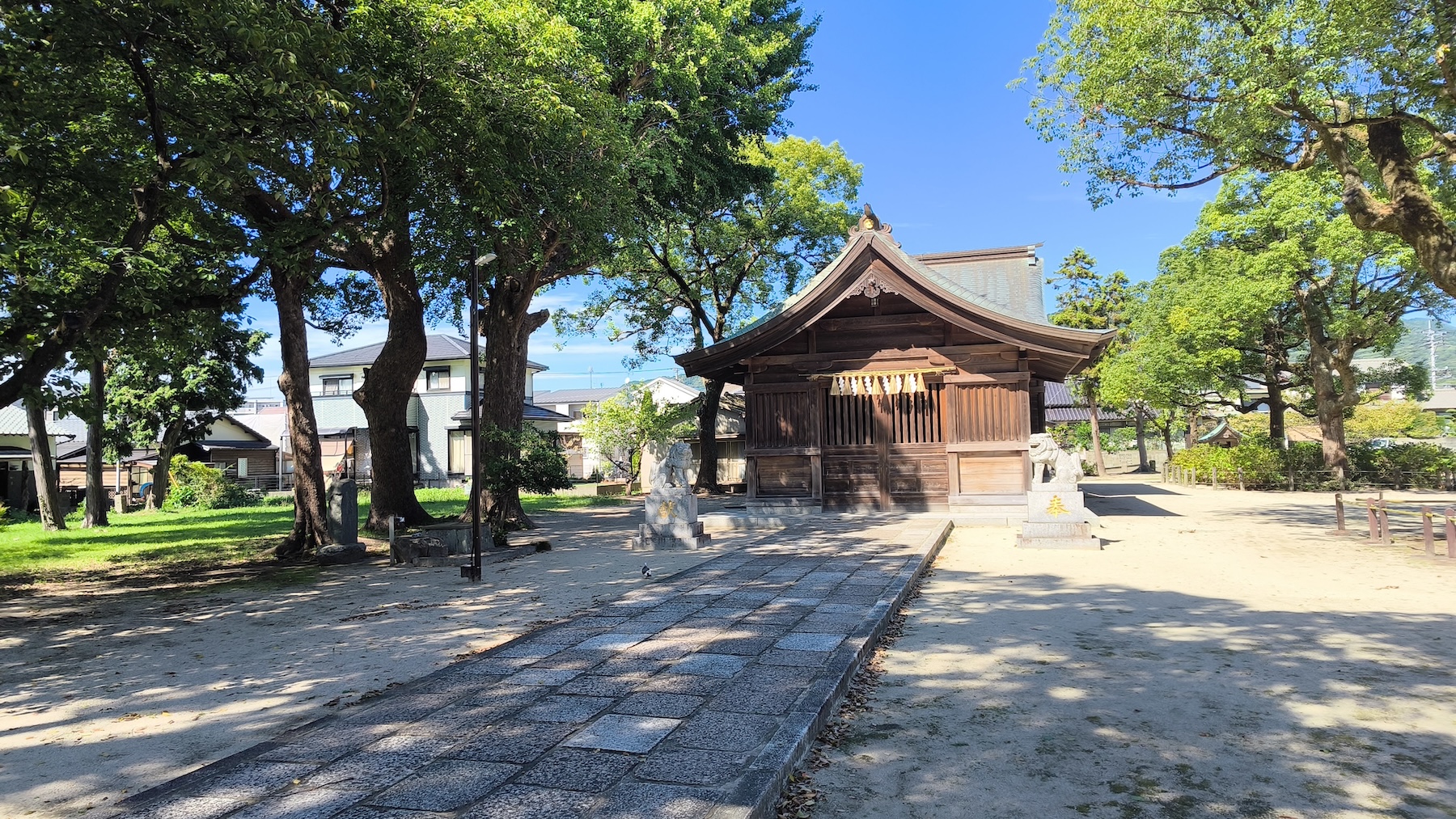
I barely saw anyone on the walk from the station. Enoki-sha itself was extremely simple: trees, grass, the shrine, and only a few houses around it. Everything felt almost too clean and too simple. There was nobody around.
It gave me a strange, almost surreal feeling. For a moment, I felt as if I had traveled back in time. The emptiness gave me a sense of the loneliness Michizane might have felt living here.
Then, beside a tree, I noticed a single red spider lily. Just behind it, someone’s laundry–including underwear–was hanging outside.
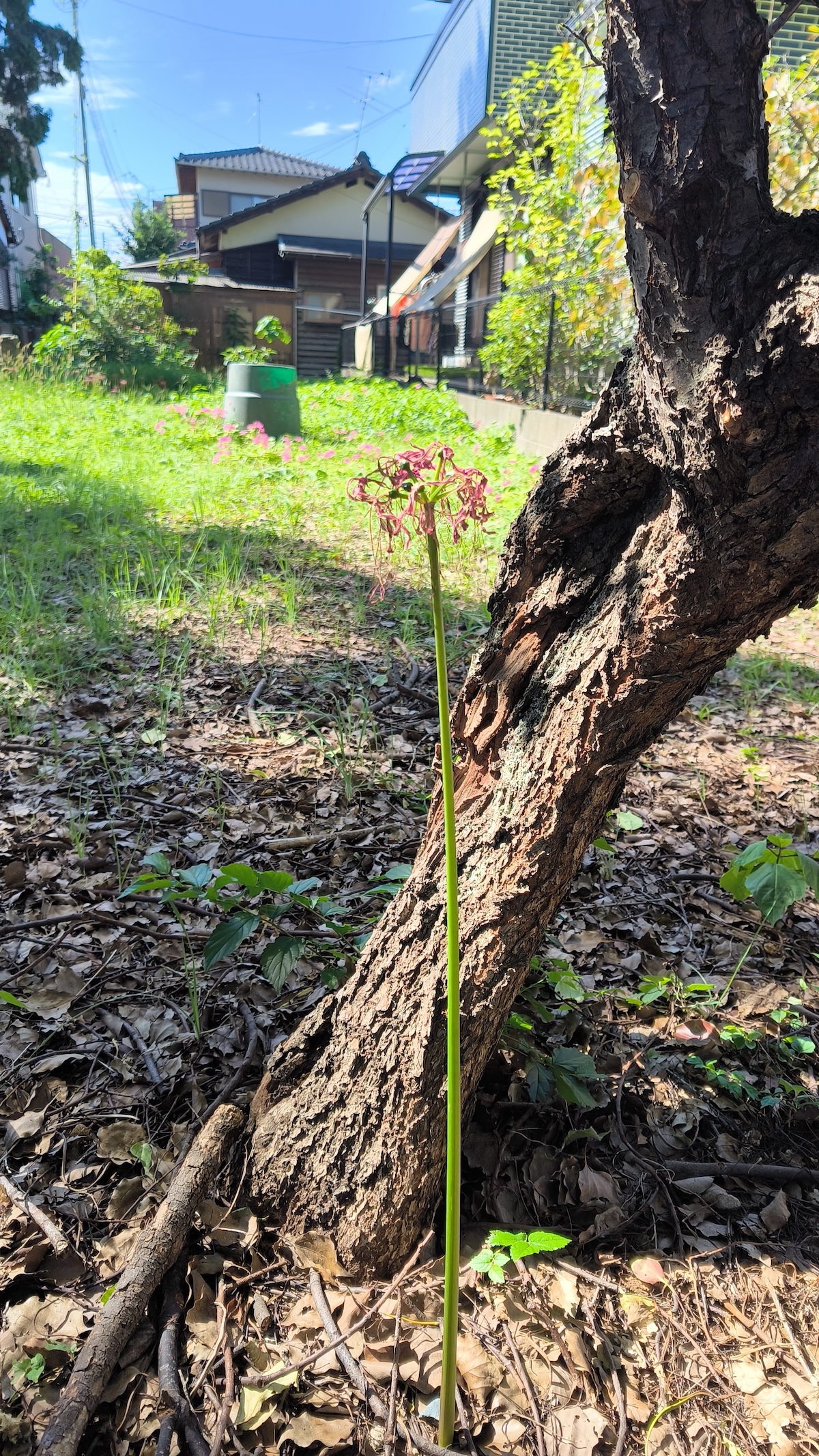
I don’t quite know why that stayed with me.
Maybe it was the contrast. I had been thinking about a man who had once been one of the highest-ranking people in the government, but spent the last two years of his life here, separated from most of his family. And right behind the flower, someone was simply living their ordinary life in 2026.
As I left Enoki-sha, the railway crossing right beside the shrine began to ring.
Kon. Kon. Kon. Kon.
The barriers came down. Two red lights flashed back and forth. Then the train passed right in front of me.
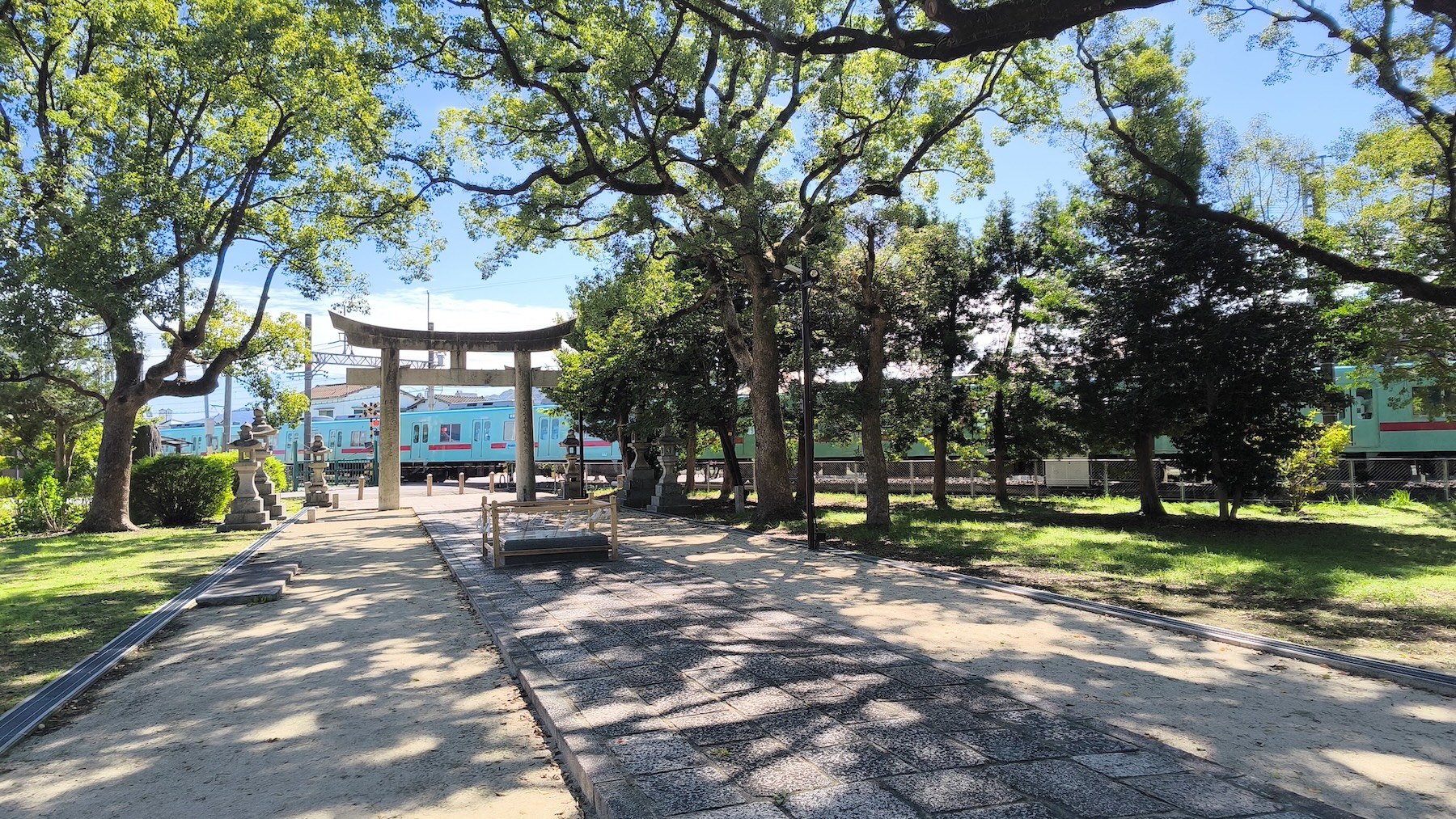
There were no cars and no people. Just the crossing, the train, and that repeated warning sound.
After the train had passed, the crossing kept doing exactly what it was supposed to do until the barriers finally went back up.
I stood there listening.
I thought about Michizane continuing to write in Dazaifu. His political career was gone. Kyoto was far away. His family had been scattered. One of the children who had come with him had died. His wife had died in Kyoto.
Still, he continued to write. He continued to hope. He never gave up on returning to Kyoto.
Maybe I was projecting too much onto an ordinary railway crossing. But that is what I carried away from Enoki-sha: the emptiness, the spider lily, someone’s laundry, the passing train, and the sound of the crossing when nobody was there.
Back to Tenjin
Michizane died in 903. If this were only a story about the rise and fall of a scholar and politician, it would end there.
But that was not the end of his story.
After his death, deaths and disasters came to be associated with Michizane’s angry spirit. People who had punished him, members of the imperial family, and eventually Emperor Daigo himself became part of the stories surrounding his supposed curse.
How that dead political figure became a feared spirit, how the feared spirit became Tenjin, and how Tenjin eventually became so strongly associated with learning is the part I am reading about now.
So perhaps there will be a Part II.
For now, I keep thinking about the students I saw at Dazaifu Tenmangu.
More than 1,100 years after Michizane died, students still line up to pray to him for help with their studies.
When I first arrived, I saw a crowded shrine full of tourists. I didn’t know much about the person behind that name.
Now, when I think of Tenjin, I also think of Michizane: a man who loved learning, teaching, and expressing himself through poetry. Someone who seemed to want to do work suited to his abilities, and do it well, yet was pulled into political struggles that eventually tore his family apart.
I went to Fukuoka expecting to visit a must-see tourist site. I came back fascinated by the story of a man I could relate to and eager to learn more about him.
What I read
I read several books while writing this essay. The one that most shaped my understanding of Michizane was:
Koji Takigawa — 『菅原道真――学者政治家の栄光と没落』(中公新書) / The Glory and Fall of a Scholar-Politician (my translation of the Japanese title).
I also referred to these books for additional historical and local context:
- Kaneharu Sato — 『菅原道真』(西日本人物誌 12)
- Hiroko Mori — 『さいふまいり――太宰府天満宮への道すがら』
- 『ことりっぷ 糸島・太宰府』(昭文社)
An earlier version of this essay was published on my company’s internal blog. I’ve made a few edits for this personal blog.
